
Look, I’m not a monster. I’m not out to help spam email get more successful and I don’t want you to open it just because it looks legit. But. What is it exactly that sets off our inner alarm bells? And why can’t I seem to stop mentally revising these unpolished gems of modern text to make them stronger?
One of my Gmail accounts has become more and more susceptible to spam–at least, it’s started ending up in my main inbox rather than one of the filters. But I don’t usually make it past the first-line preview before manually filtering it when it reads as, well, off. Here’s an easy one:

I mean, there’s so much to work with here. The poor kerning (space between marks, like the extra one before that comma), the inconsistent capitalization, the vagary. And, of course, the total absence of my actual name.

What is this sender name? Was it chosen to convey a certain gravitas, or a plausibility because of its complicated spelling? There’s nothing grammatically wrong with the first line–in fact, it reads a bit like a Netflix adaptation of a Regency-era novel. And I think it’s exactly this stilted aversion to a direct object that’s creating a distance from the email’s reader: this is not how I expect a business to sound in the 21st century.
That distant, convoluted tone continues through the rest of the message, as does the affected formality and the random grammatical errors. It’s the combination of overly-formal and overly-rough that does it for me, really. This does not pass the uncanny valley test.
Let’s try another one from the same day (a bad day: I had to manually remove seven). Again we start with a delightfully non-specific subject line,

Followed by the actual address of the Treasury–

And then back to an incredibly vague header: even a mass email from a government agency would have an auto-filled name for each recipient.
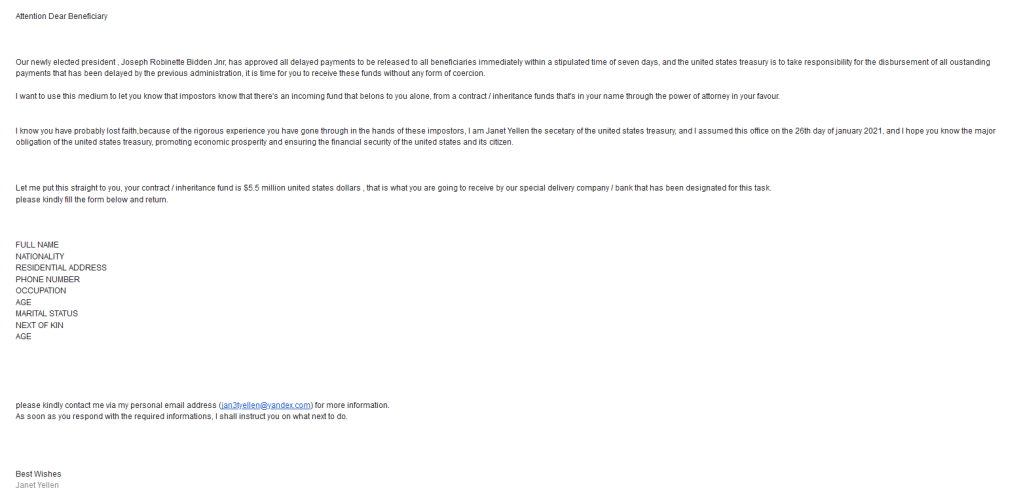
Additional flag moments:
- The misspelling of the President’s name, but also the inclusion of all his names
- Lack of capitalization
- British spellings
- The inclusion of only the most basic and easily-Googled information about the sender
- The list of
phishingpersonal data that’s not actually any kind of form and also the Treasury probably knows all this - The two email addresses (sent from and at the bottom)


If these spammers were to give me fifteen minutes to revise their clunky attempt at trust-building, it would really only be a few tweaks and then most of us might actually click on these messages (I did, but only so I could have some fun with them here; usually they’re straight into the bin). Luckily for all of us, my spammer rates are MUCH too high for them to afford, since they almost certainly don’t actually have those millions they’re promising. For the rest of us, spam email gives us an easily-available short list of what not to do in our email campaigns.

 Something Polished